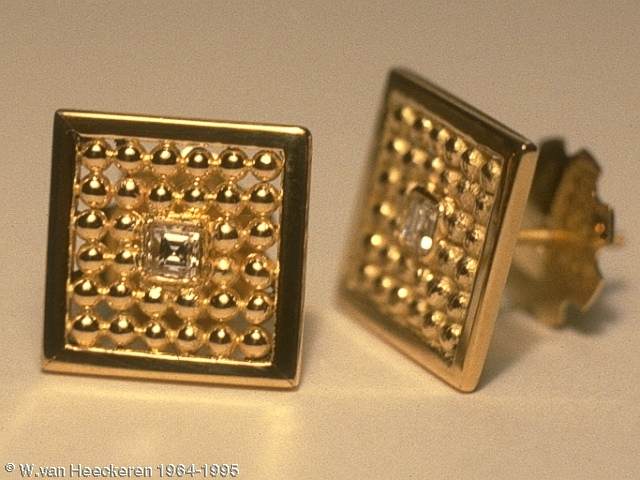
Technical Data for DIAMOND.
name:                          DIAMOND
colour:                        Colorless, yellow, brown, sometimes green, blue, reddish, black
colour of streak:              None possible
mohs hardness:                 10
specific gravity:              3.47 - 3.55
cleavage:                      Perfect
fracture:                      Conchoidal to splintery.
crystal system:                Isometeric ( cubic ); mainly octahedrons, also
                               rhombic dodecahedrons, cubes, twins, plates.
chemical composition:          C, crystalised carbon.
transparency:                  Transparent.
refractive index:              2.417 - 2.419
double refraction:             None, often anomalous.
dispersion:                    0.044
pleochroism:                   None.
absorption spectrum:           Colorless to yellow: 4780, 4650, 4510, 4350, 4015,
                               4230, 4155, 3900 Blue-green: ( 5370 ), 5040, ( 4980 )
fluorescence:                  Variable; Colorless and yellow: mostly blue. Brown
                               and green:  often green.

GRANULATION.
    Granulation is so called because of the practise of using tiny
                        spheres no larger than grains, or granules in the
                        process.  Simply put granulation is done by
                        preparing gold granules of the same size, these are
                        then glued in place with a mixture of organic glue
                        (such as gum tragacanth), and a powdered copper
                        bearing material (such as cupric hydroxide, cupric
                        oxide, or cupric acetate).  once the glue has dried
                        the whole item is heated in a reducing atmosphere
                        (such as a charcoal fire).  during the heating the
                        glue gets driven off as carbon dioxide, the copper
                        bearing material reduces to metallic copper, and
                        the metallic copper then alloys itself with the
                        parent metal.  This causes the surface of each
                        granule to have a slightly lower melting
                        temperature than the parent metal, but only at
                        their contact points, and these contact points then
                        "fuse" together before the whole object melts.
                        You can tell Granulation by it's characteristic gaps
                        between the granules. If the granules have been
                        soldered in place, the gaps will be flooded by solder.
                            Granulation was brought to it's highest form by
                        the ancient Etruscans, who used beads, or granules
                        down to a size of 1/240th.  of an inch.  They used
                        to build not only nice flat decorative patterns
                        with these beads, but actually stacked them to form
                        small three dimensional figurines.

                                                    Wal.